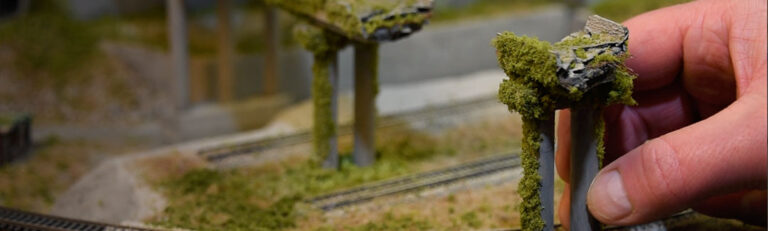
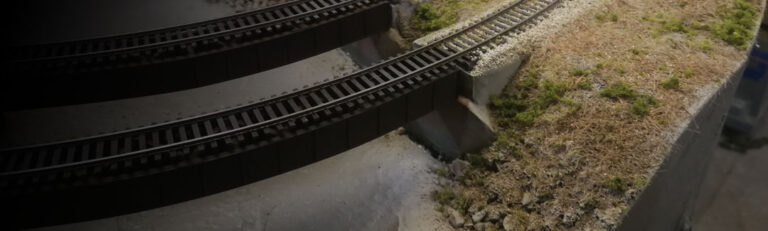
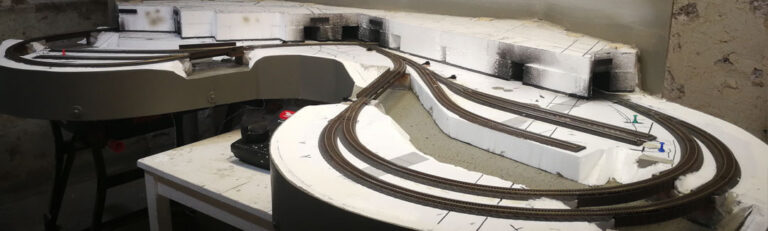
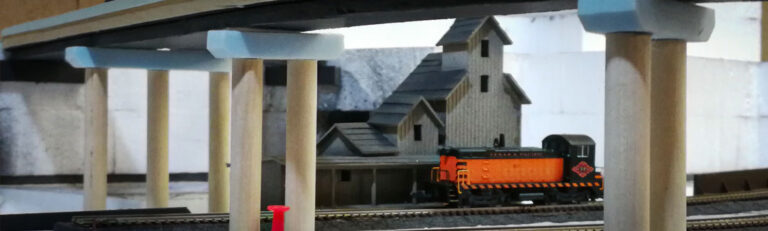
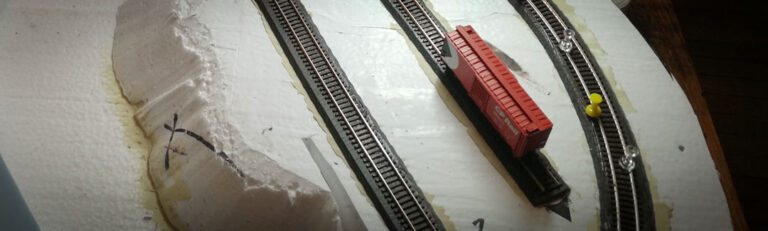
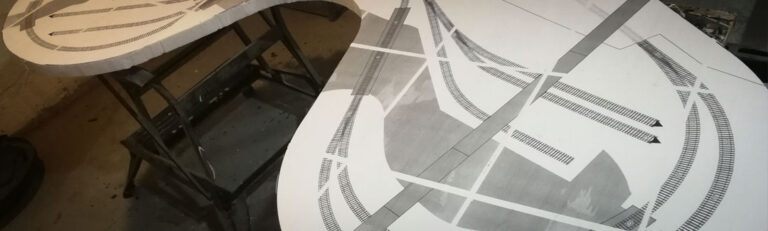
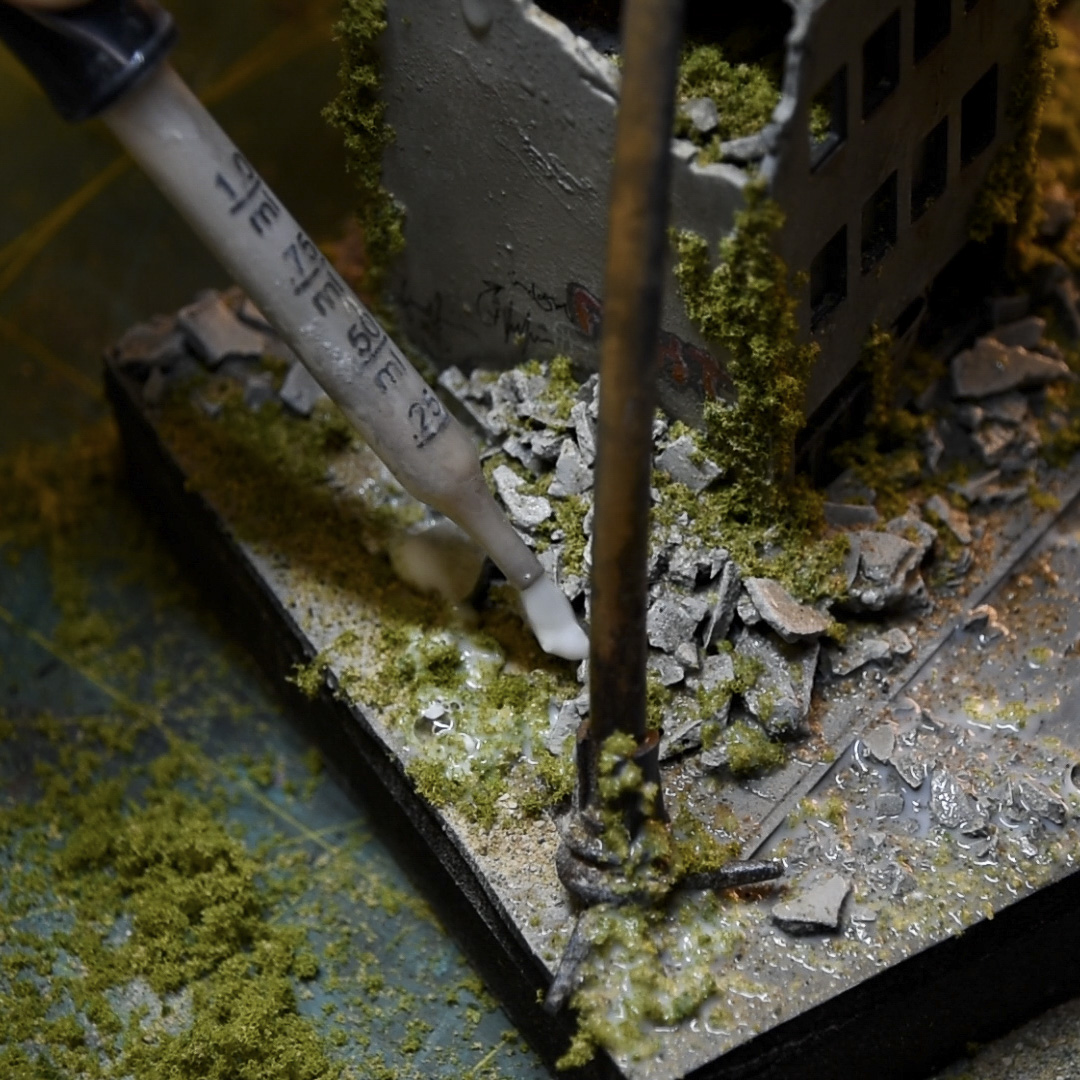
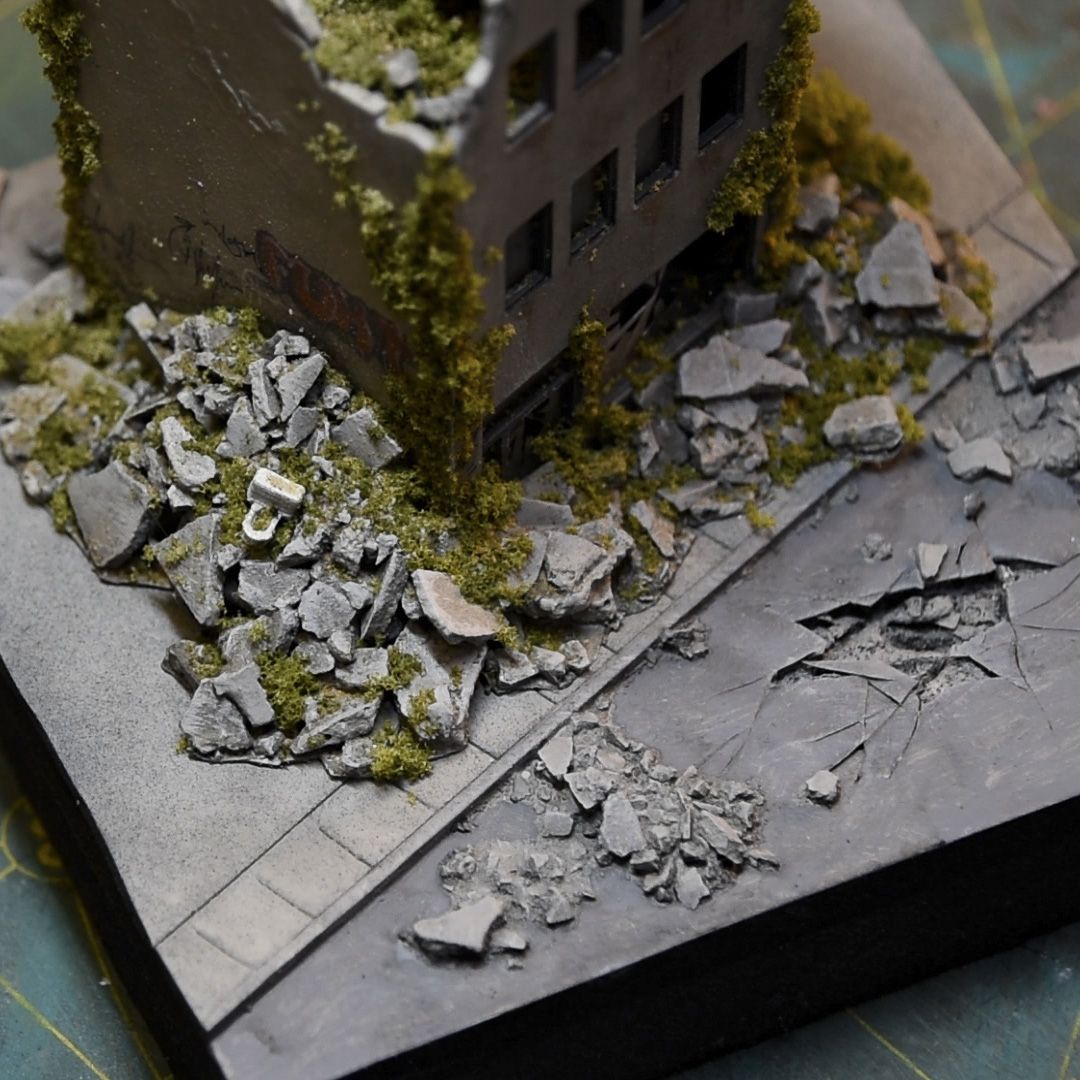
Progress on the WGR has been slow of late, but I’ve managed to finally finish laying the track.

As mentioned in an earlier post, the switch machine dilemma was one factor responsible for the summertime pause. However, once I was able to finalize the switch machine design, progress ramped-up considerably.

I’ve yet to wire each of the turnouts and fix-up some of the roadbed, but the track is done and initial tests suggest that everything is running smoothly.

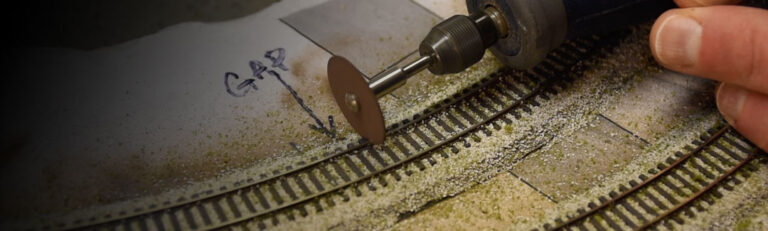
I feel it is worth mentioning that I modified my track laying technique for the WGR. I have traditionally used clear latex caulking as a track adhesive (impressed by the adhesion and ease of use) however the process of applying adhesive before track can get rather messy when track is adjusted (in order to join ends etc.).

Shifting track once its be seated in the caulking forces caulk up between the ties – creating a annoying mess that must be cleaned up. In order to avoid this, sections of track with absolute positioning were fastened using caulk, and those sections that needed tweaking were pinned firmly in place and then covered in diluted white glue and wet-water – just as in ballasting.

I had some fears that the glue could ‘let-go’ once I start ballasting, however as I’m intent on painting the rails and ties, the track should stay in place – if by nothing more than the adhesive properties of the paint alone.

One of the challenges I’ve been trying to solve over the last few months is what to use as turnout controls on the WGR. While foam bench work offers many design advantages (ease of construction, weight etc.), its solid structure complicates installing switch machines – a practice greatly simplified in open-grid bench work designs.

I wanted to avoid the use of manual turnout controls – for appearance reasons only – so I’ve spent the last while trying to develop a cheap/reliable controller. Likewise, the isolated frogs on the A55 switches need power routing – an additional benefit of using the slide switches.

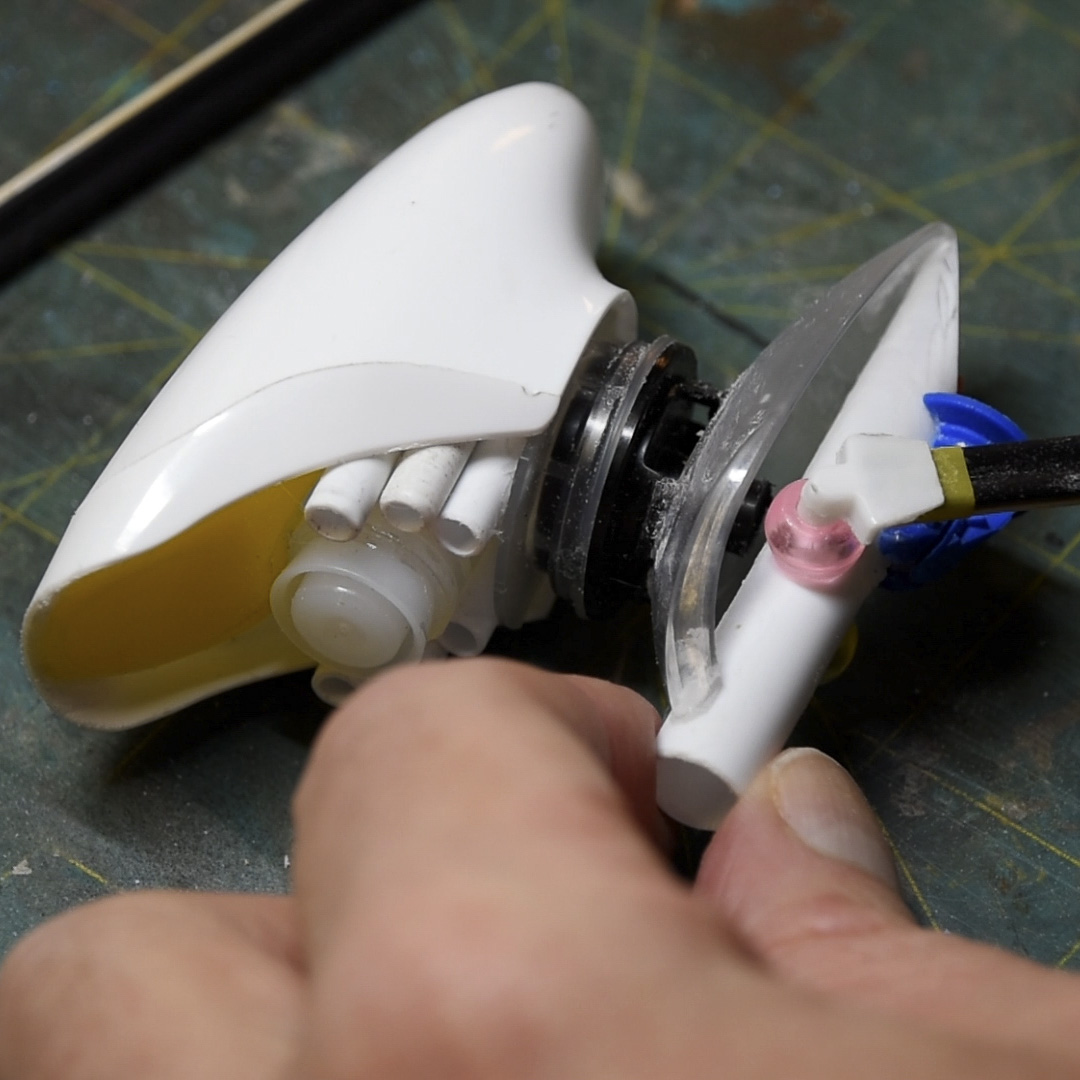
I developed my first controller using a slide switch to control the points, and a ‘choke-cable’ arrangement to activate the switch. The ‘choke-cable’ is made from small-diameter gas line tubing and aircraft cable. I assembled a temporary test switch and was happy with the results.

I refined the design further such that the controller consisted only of a slide switch epoxied to a small scrap of styrene, with the aircraft cable drilled/glued to the slide, and the point-control wire.

I installed the controllers by carefully carving a small 1” deep cavity directly beneath each turnout throw-bar, and affixing the entire assembly into position using hot clue. Each of the control lines were embedded in channels carved in the foam, and covered with very thin styrene.

I am surprised how well these controllers work. I’ve since finished the track work and the choke cables work flawlessly. Once I’ve installed the fascia, I’ll add some knobs to the ends of the controller cables.

Rather then write more on the assembly; I hope the pictures will suffice.

I generally steer clear of model railroading related philosophies, but after reading this post I thought the author deserved a mention. David K. Smith articulates some of the issues within the model railroading hobby quite eloquently. Titled “Members Only”, David discusses the apparent divide between ‘model railroaders’ and ‘modelers’ – discussing the difference between those who play with trains like the ‘real thing’ and those who enjoy the hobby for the diverse appeal.

Based on what I read, it appears that I am a ‘modeler’ – a title I’m happy with.

Members Only – 1-160.blogspot.com

Reader’s have undoubtedly noticed that this site has been fairly inactive for the past few months. Trust me when I say it has nothing to do with a fleeting love of trains, just that sometime ‘life’ happens! Since my last post my brother-in-law came to live with us for two months, the basement flooded, and we are selling our house.  As such, there isn’t much time left for trains.  Likewise, I’ve never really had a drive to play in the basement during the summer months.

Anyway, I hope everyone is having a pleasant summer – looking forward to the fall train surge!

progresssmall.jpgSince my last post, progress has slowed significantly. Outside of the regular day to day distractions, I’ve had to do a great deal of thinking about how I will proceed with several aspects of the layout. Firstly, I’ve had to consider how I am going to control the turnouts, and I’ve been working on creating a remotely controlled switch machine using small SPST slide switches, aircraft cable and gas-line tubing. (A post to follow on this – I promise!)

Second, I’ve been deciding where to start laying track as this will dictate where I finish – I don’t want to get caught trying to make the last join on a curved grade at the throat of the yard.

Finally, I’ve been using some 1:1 paper turnouts to continually test my track configuration. I’m not entirely happy with the length of the run-around track – about 4+ cars – but operationally it doesn’t have a huge impact, and other configurations tend to undermined the overall ‘look’ I’m trying to achieve.

That being said, I have managed to install 95% of the roadbed, and started to lay some track. I opted to give the Woodland Scenics roadbed another try – despite having difficulties with it the first go ’round. The big factor here was cost – it cost me $6.00 for the foam roadbed whereas cork would have cost me $30.00, therefore, foam was the obvious choice.

I glued the foam to the baseboard using slightly thinned white glue – brushing a wide swath of glue over the centreline of the track. I pinned the roadbed in place using push-pins, and once satisfied with the positioning, a brushed some additional glue along the shoulders of the roadbed for good measure. I’m not convinced that white glue is going to offer the same adhesion strength that adhesives like PL300 provide, but I didn’t want to have to carefully smooth beads of glue with a trowel in order to get a even surface – the high viscosity of PL300 and the like require all lumps to be smoothed out, otherwise they will create bumps in the roadbed – a noticeable imperfection in n scale. Once the ballast is glued in place I’m confident things will stay put.

As for the track – my first impression of the Atlas’ Code 55 is good – nice to work with and great looking. More on that later.

progress1.jpg

progress3.jpg

progress4.jpg

progress2.jpg

foam2small.jpgProgress of late has been swift and I’ve almost completed all of the foam benchwork ‘ including the elevations for roads and highways. It took more time to remove the old glue leftover from the false start on the previous incarnation of the WGR then it did to actually construct the new risers!

I read a post by another modeler detailing the he too was going to attempt to use foam exclusively as benchwork material, but was having difficulty making perpendicular cuts using a knife. He went on to explain how he finally discovered that his jig saw was a far better alternative. Using his level as a fence, he guided the saw offsetting the level from the cut line the distance from the saw blade to the edge of the saw foot. Apparently the result was a ‘butter smooth’ perfectly square cut. I’m eager to try this, however as I’ve already finished the majority of the benchwork, and in my household ‘noise’ is a big issue, I’ll leave it up to others to try this technique and decide how it works.

A challenge I needed to address with the foam risers was the gaps in the curves. Woodland Scenics sells a foam-putty intended for gap filling, and using something similar such as drywall compound had crossed my mind. One of the drawbacks of compound is that it really doesn’t stick to foam. I had used it on the NES for gap filling and it worked well, however I learned that I could easily peel it away from the foam, which didn’t reassure me that I really wanted to depend on it for keeping my track secure.

I opted to drape glue-soaked paper towels around the top and sides of the risers and it has worked out well. I slathered the foam with some 2:1 glue/water and then applied the strips of paper towel – brushing everything as smooth as possible as I worked. It took little time to cover all of the risers and the results are rock-solid. The paper towel fused the risers into one continuous run, and the gaps are effectively filled. While white glue won’t permanently fuse to foam, wrapping the paper towel around the sides should result in a secure bond.

foam21.jpg
foam22.jpg

foam23.jpg

As the benchwork progresses I’ve had some time to test some 1:1 track planning and I’ve been making small modifications to the plan. I decided that I would stay from the prototype in favour of a slightly more operational yard. Granted ‘ the yard is small ‘ but isolating yards movements from the mainline will be advantageous. One of the benefits is that the track itself ‘looks’ more like the prototype, even though it’s not the same.

Likewise, a suggestion was made by a reader that I consider including the now defunct Nova Scotia Textiles building. While I cannot pinpoint the exact location of the mill, I do know it resided on King St., overlooking the Windsor yard ‘ so for the time being I’ve included it as part of the design. I’ve had difficulty finding any images of the mill, so if anyone can direct me toward any images I’d be thankful!

wgr3.jpg

textile.jpg

fhs.jpgThe last few weeks have seen a sharp decline in RR efforts as life’s usual trappings (work, family, house) have needed some attention. That being said, my track and turnouts did arrive from Fifer Hobby Supply and I want to take an opportunity to laud Mike and Robin Fifer on their business.

I knew nothing of FHS until I became a member of the nscale.net community and read endlessly positive comments about their business. Based on these recommendations I decided to give FHS a try.

There was nothing unique about my order ‘ some C55 atlas track and switches. Despite the recommendations I thought I would do some online price shopping and see how things compared. In the end I found only one store that had the same offerings for a marginally lower price ‘ but as they did not ship to Canada the point was moot (not to mention I had never read a single positive review about them).

The FHS online store indicated that one item was out of stock. I contacted Mike and Robin who took my order in full via email and assured me the stock would arrive shortly. The refused to let me pay for any of the order until it was ready to ship. Shortly thereafter I got an email noting all the items were in stock, and they sent me the final tally including shipping ‘ a very good price!

When my order arrived, it was immaculately packed and undamaged. Based on the size of the package and the distance it travelled I was convinced that that shipping costs were very fair (if not low), and it was evident that FHS hadn’t tried to hide some handling costs to increase revenue. The only added expense was the GST and PST ‘ duty did not apply.

In the end my order cost me about 45% less then it would have had I shopped at ANY of my local hobby shops. Typically I would support local businesses, however the price difference was too great, and upon reflection I grow increasingly aggravated with my LHS as I question why their prices seem so out of line with others. On one hand I’m sympathetic to the inherent costs of having goods shipped internationally and paying rent, but our recent (and sustained) dollar parity hasn’t been reflected in local prices which makes me rather suspect of my LHS prices. If you aren’t going to attempt to pass along your savings to me then I will shop elsewhere.

In closing, Fifer Hobby Supply is a friendly, competitively priced, easy to use online store staffed by genuinely nice people who take pride in their business, value customers, and understand the benefit of good communication. I wish you continued prosperity and look forward to placing my next order.

Keeping with my ambition to construct the majority of the WGR with foam, I have been experimenting with a few different construction techniques in an effort to create foam risers much like those offered by Woodland Scenics. Although my first efforts have been removed due to a change in track plan, the technique I used was very straightforward and fast – allowing me to construct all of my initial bench work in a few evenings.

Step One: Transfer the track plan onto the baseboard, and mark the elevation endpoints. In this example the track is crossing over itself so the elevation endpoints account for a ‘bridge’ and the track below it.

ele1.jpg

Step Two: Draw a line following the inside curve of the area, offsetting the original centerline by 1″. The 1″ offset allows for the foam (in this case 2″) to follow this new smaller circumference as a guide, so that once installed the risers foam can be easily cantered over the original plan. With this new guide drawn, measure the total length between elevation endpoints using a piece of string.

ele2.jpg

Step Three: Transfer the length of the string on a new sheet of foam and mark each end with the starting and ending elevations – these elevations should be drawn perpendicular to the riser length – in this case 0″ and 2″. Connecting the two points will create a long wedge that represents the grade between the connecting points.

ele4b.jpg

Step Four: Using a sharp utility knife, and a thick straightedge (such as a board or a level) make light cuts by continuously draw the knife through the foam along this line, keeping the knife against the straightedge to ensure the cut is both strait and square.

cutfoam.jpg

Step Five: Cut the ‘wedge’ into 2″ long segments

ele5.jpg

Step Six: Using foam-safe glue such as PL300, affix the wedges along the edge of the inner line – ensuring that each corner touches the next (unlike the illustration), otherwise the resulting grade will be to long.

ele3.jpg

Finally, once the glue has completely dried, any imperfections can be removed by lightly sanding the tops of the risers using a sanding block or rasp.

There you have it – a fast and dirty tutorial on how I created my original grades. Now I just need to get to work on the new plan!

newplansmall.jpgAfter having scrapped the initial WGR plan, I decided that I would revisit my collected references on the WHR’s Windsor Yard – the original inspiration for this project. The more I considered the function of Windsor Yard the more I realized that it was this singular location that I was interested in and that I should base my new design on this area. Likewise, I started rethinking my space and my desires. The original WGR plan had utilized all sides of the baseboard and as I started building the risers I started to truly appreciate the space needed to operate the pike from all sides – the space required for a full perimeter layout defeated the purpose of building a small pike as I now required several feet of space on all sided of the layout to run it. Therefore, I considered how the plan might work if I treated it as a deep shelf, and if I eliminated Windsor Junction. The result (seem below) was a more accurate depiction of the yard as well as the surrounding geography. At first I was disappointed at ‘what I had lost’, but I started to realize all that I was gaining. This arrangement allows for deeper scenic treatments, and improves the track/scenery ratio – focusing on the neighbouring fields, highway and the all important ‘nothing’ in between.

I sat on this idea for a day trying to decide if I would be happy with this new approach when I received an encouraging note from a reader, Allen, who in one fell swoop characterized the function of Windsor Yard, and offered an approach that was similar to what I had been considering. This input has wiped out any doubts I had about this more minimal design, so without further ado, I humbly present the new WGR – leaner and meaner! (I’m still considering the track arrangement in the yard – so things might change slightly over the next few days)

Side note: one of the details that has been staring me in the face since I started considering modelling this railway was the fact that I can easily include some passenger operations. The WHR offered a seasonal passenger service along the Evangeline Trail – a perfect excuse to model some unique passenger equipment!

newplan.jpg

wgr.jpgI’ve completed the WGR bench work, and having spent the last few days staring at it I’ve concluded that I’m not happy…

I was pleased with the design when I conceived it, and I’ve had an opportunity to think about it for a few months and in that time found little fault – always bearing in mind that this was a small layout, and with that came trade offs. Despite this, the one aspect I couldn’t visualize was the grades, as well as the volume of hidden track. Now having had an opportunity to take a better look at things I realise that both are a bigger trade-off then I imagined. Hence, I’m starting over…

So what’s next?

The baseboard is still good and I can ‘easily’ remove the risers, and the track and turnouts I’ve ordered can be repurposed. The only issue at this point is re-evaluating how I want to go about representing the WHR prototype. Despite best efforts I don’t think it’s possible to capture both the essence of the region as well as operations in a small space.

The more I consider it, the more I’m leaning towards doing a single element of the WHR – such as the Windsor Yard. I would like things to be continuous run – so I’ll need to give this some thought! Stay tuned!

foamsmall.jpgAfter having spent some time building the NES, looking at other layouts, and reading about construction techniques, I was convinced that it was possible to build a layout that was almost completely made of foam. Conventional wisdom dictates that layouts be built to museum quality standard ‘ with heavy duty wood construction ‘ but often times that is a necessity of building a layout that is, well, heavy duty. I decided that if I were to attempt to build the WGR using foam exclusively, such construction techniques would be unnecessary as the layout itself wasn’t heavy duty.

A trip to the local DIY store offered a rather sobering perspective on foam, as extruded foam ‘ the modelers foam of choice ‘ was also quite pricey, costing well over $ 25.00 for each 2″ thick 2′x8′ sheet. Needing three sheets of foam for the project, I considered scrapping the whole foam idea in favour of plywood as its cost would be a 1/3rd that of the extruded foam. Just as I was about to commit to some ¼” birch plywood, I noticed a new foam product called Plastispan HD expanded foam. Apparently this newer product is considered mid-grade ‘ better then the standard white foam, but not quite as good as the extruded pink/blue stuff. It is considerably harder then the white bead foam, and much less crumbly. I threw caution to the wind and decided to give it a shot.

The WGR is 34″x72″, which would have fit on a door, but wanting to stick to my foam commitment, I decided to construct the baseboard out of 1″x2″ pine with support stringers every 16″. I glued and nailed a simple frame together and then attached the sheets of foam using PL300 adhesive, and let the entire assembly dry for a few days.

Once dry, I started transferring the trackplan onto the baseboard. Using a stick for a compass, and some photocopies of turnouts, I marked, traced and plotted the basic track arrangement. I wasn’t surprised to find that despite best intentions, the trackplan wasn’t going to be a perfect fit, as my turnouts needed more space then estimated. By reversing the turnout arrangement on one section of the wye, and eliminating one of the hidden staging tracks I was able to make everything fit.

For risers, I opted to use foam ‘ I’ve been looking at the Woodland Scenics foam risers and deiced that it would be straightforward to construct something similar ‘ the advantage being that the cost would be greatly reduced, and I would be able to create custom grades. To make the risers, I measured the length of the curve/strait section of track I was working on and transferred the length on to the foam. I then marked the heights that the grade needed to rise over that distance on the foam, and cut the foam into a large wedge. I scored and snapped the foam every inch or so and glued the riser segments to the baseboard ensuring the inside edge was butted tight against one another. Work went quickly, and in the course of three hours I managed to construct all of the risers seen here.

My mind is already buzzing trying to figure out how to scenic all of these grades. Many will be hidden, but other will need some creative camouflage is order to maintain some believability. That being said, the foam experience thus far has been very positive! Looking forward to the next stages!

foam-001.jpg

foam-002.jpg

foam-003.jpg

foam-004.jpg

foam-005.jpg

foam-006.jpg

foam-007.jpg

wgr.jpg(Originally posted on nscale.net)

I’ve been fortunate enough to have spent the past year working on my Niagara Escarpment System – as small freelanced 2×4 layout set in south western Ontario. In this time I’ve learned a great deal building this, my first layout, and now better understand what I’m interested in, what my goals are, and what my next steps should be. I promised myself that I would ‘finish’ the NES, and I’ve done that. The layout isn’t done by many standards, but as whole it’s been completely sceniced, runs well, and has sated most of my desires. Now on to (slightly) bigger and better things.

The WGR will be loosely based on the Windsor Hantsport Railway, a 56 mile railway operating in Nova Scotia, Canada between Windsor Junction and New Minas with a spur at Windsor serving two gypsum quarries at Wentworth Creek and Mantua. The WHR’s primary commodities include gypsum, rock, grain, vegetable oil and lumber. The majority of WHR traffic originates at the two gypsum quarries on the spur running east of Windsor, whereby the gypsum is hauled by unit trains to the port at Hantsport. I was smitten with this railway while visiting family in Nova Scotia and as it is a fairly small operation, it lends itself well to my desires.

Over the course of the last few months I’ve been able to develop a trackplan that should lend itself to my current needs, and while by no means a realistic condensation of this prototype, I believe it effectively captures many of the features indicative of the shortline, embodying the essence of the railway as a whole.

With that, I’ve set out a modest set of goals which I aspire to obtain. Some remedial, others more involved. For the most part all of these guidelines have been set in an effort to become a better modeler, and to broaden my scope of the hobby.

Benchwork

I have every intention of building 95% of this layout using extruded foam – benchwork included. With the exception of support stringers my hopes are to demonstrate that a excellent base can be constructed almost entirely of the pink stuff. I like woodworking, I have lots of tools, but I think that some stray away from constructing ‘custom’ baseboards as the woodworking component is too daunting. I think this tends to limit modelers to settle with doors, sheets of plywood or DIY shelving for their base, and I’d be happy to prove that a anything is possible with the right materials. (Let’s see if this one comes back to haunt me!)

Track

I’m excited about trying Atlas’ code 55 series, and I’ve already placed my order. The NES used the standard code 80 track common at most hobby shops as well as some Peco switches I had on hand. I’ve been happy with the results of these items, and wouldn’t want to discourage anyone from using them, but I’m now ready to try something finer. As well, my trackside scenery treatments were a little cavalier on the NES – I picked a ballast colour I liked and went with it. However, looking down the lines of all the railway crossings in my local area, I’m starting to appreciate that modeling track is like anything else and is aided by reference the real thing.

Scenery

I’m not a rivet counter, but I would like to become more of a ‘daisy counter’. Scenery is the most enjoyable aspect of this hobby for me, and I’d like to improve upon the results of the NES. I’ve spent a good deal of time looking over the work of modelers such Pelle Soeberg and Josef Brandl, and once of the most striking differences I’ve noted is how they accurately model the things that aren’t trains. Proper elevations on roads, believable lot sizes for residential areas, drainage etc. – details that I considered only as an afterthought. Likewise, I need to teach myself to look at scenery ‘prototypes’ more, be that my backyard, or aerial photos of different railways. I’ve got a good deal of art school training under my belt and one of the first things you learn is that you need to ‘look and see’. I’ve ignored this advice and have been happy to work from memory – a memory that remembers things as a whole, not the details. What colour was the ballast? What shape is a maple tree? A few moments of reference for these and other questions will undoubtedly improve my modeling efforts.

Structures

Scratchbuilding is a wonderful hobby within a hobby, and I’m quite taken by it. Every structure on the WGR will be scratchbuilt – I enjoy the practice and it allows me to enjoy the hobby with but a small toolbox and the kitchen table – a nice reprieve from the basement dwelling that is too often the life of a modeler.

Motive Power and rolling stock

I optimistic that this endeavor will allow me to casually learn more about the subject of all layouts – trains! I’m admittedly ignorant with all things on wheels and I think basic investigations about the engines and cars of the WHR will help expand a very narrow knowledge base. I’m not looking to get a degree in engines, but just a better understanding of the history and uses of motive power. Likewise, I’m working up the nerve to scratchbuild an RS23 – the past engine of choice on the WHR. I’d also like to actually try detailing some equipment, weathering it at the very least!

Overall

I’d like this next project to be a sum of its parts. I’d like to create a pike that is effective overall. If a casual survey of the pike is pleasing then the project has been successful. I dislike sore thumbs, and they catch my eye all the time. I’m striving for unity – a homogeneous relationship between all elements that make up a railroad. If close inspection finds a flaw, that’s okay – it’s the first impression I’m interested in – besides, if I take the time to ensure that the railroad works as a whole, I will be satisfied.

So what of the NES? I still have one little lighting project I’d like to attempt, and then I will wrap the entire thing in plastic and store it safely. I have no intention on cannibalizing the layout, as I want to start new. I also have no intention of trashing the layout as I’ve invested a good deal of time in it and I want to keep it until the next project comes along.

So there we have it, a rather long winded introduction to the WGR – now that it’s in print and public I have no choice but to stick by my words… Oh mercy…

I managed to purchase some bench work supplies this week to start the new layout (introduction forthcoming) which means that I’m now committed to my Windsor Gypsum Railway Co., I can officially cease all work on the NES. The NES hasn’t had a lot of run time – the majority of my efforts have been spent learning about scratchbuilding and developing scenery techniques. As such, it seemed only fair that I run a few trains ’round the loop and shoot a few photos for prosperity. So here you have it – the final run of the NES. Thanks for the ride.

fallenflag8.jpg

fallenflag5.jpg

fallenflag6.jpg

fallenflag7.jpg

fallenflag4.jpg

fallenflag1.jpg

fallenflag2.jpg

fallenflag3.jpg

trackplantools.jpgI’ve spent some time over the last few years surveying a number of different software solutions intended to help users design their model railroad – most recently trying Altas’ RTS. Each of the programs I’ve tried have offered a fairly comprehensive set of tools, and allowed users to draw simple track plans. Beyond that scope, most of the programs tend to get far too complicated – at least for casual use. It strikes me that despite best efforts, designs never quite work in practice, and serves the users best as guides rather then blueprints. As such, I’ve will continue to rely on Adobe Illustrator as my program of choice.

As I iterated here, Illustrator is not a program that many people use – at least not in relation to its big brother Photoshop, and it is geared to the graphic design industry, not CAD. That being said, I have found that it’s easy to lay out basic radii and switches and get a sense of what will fit in a space using the program, and to use these drafts as a guides, as ‘real’ track planning is done on the baseboard.

With that, I did happen across a fairly useful little plug-in for Illustrator intended to help users draw track plans. Developed by Rick Johnson (senior illustrator at Model Railroader Magazine), this plug-in helps draw switches, crossovers, basic curves, strait track sections and stubs. Elegant, simple, and fairly comprehensive (you can specify the turnout size by simple holding the turnout number down while clicking) this inexpensive plug-in works well, and removes a great deal of headache.

Rick offers the plug-in as a shareware release with a limit of 100 uses before he requires the user to pay $15 to register. The 100 uses is more then enough for any user to adequacy try the tool, and the $15, well, money well spent!

http://rj-graffix.com/software/plugins.html

« Previous PageNext Page »


Recent Posts