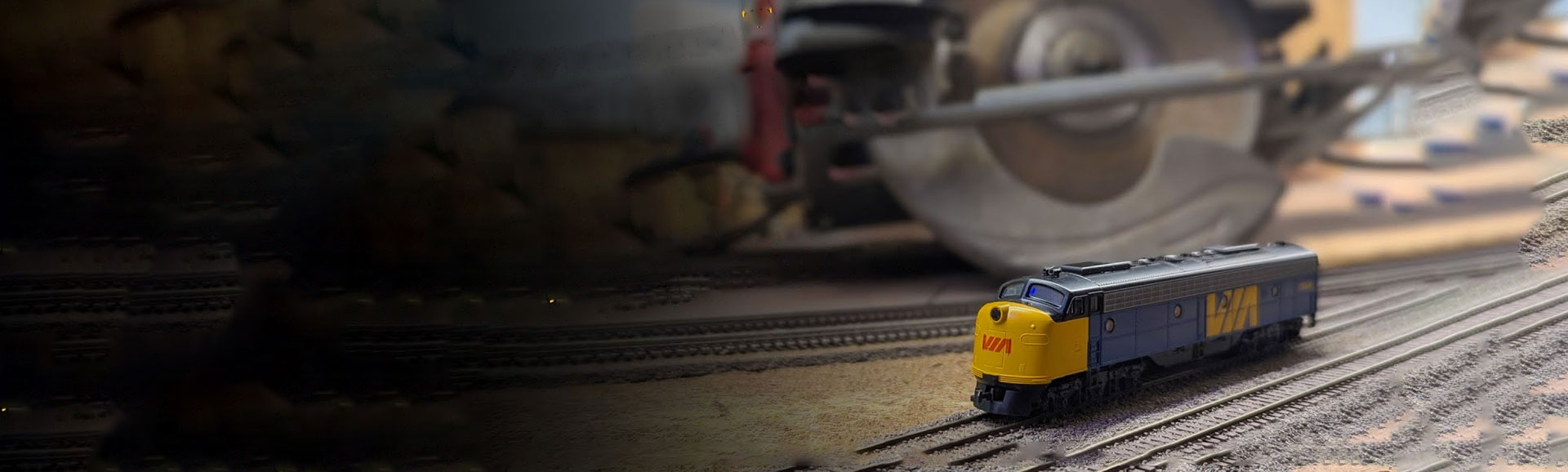
When I regained my enthusiasm for model railroading, I came back with a clear sense of what I wanted. I knew I was drawn to modeling passenger operations in Southwestern Ontario — something modern, something local. Freight operations are everywhere, but there’s something more niche and creatively challenging about getting passenger service right, and that interested me.
At first, I got started with a few little Japanese light rail and subway sets. They weren’t era-appropriate for the layout I imagined building, but they were affordable, and more importantly, they were available. They showed up on my very first dystopian layout, and in a way, they made sense. In a city with diminished ridership, small trains crawling through forgotten spaces felt appropriate. That was the quick fix that got things rolling again.
Once I started looking for regionally accurate equipment — VIA units, Canadian passenger cars — I quickly realized just how little was actually available. My earlier experiences with the hobby had been built on chance and impulse: walk into a hobby shop, browse the shelves, pick something that caught my eye, and bring it home. Road name, color, paint scheme — those were the selection criteria. It was spontaneous, and it worked for what I wanted at the time.
But this time around, I was being more curatorial. I had a specific vision, and I wanted to build toward it. The problem was that there wasn’t much to pick from. Hobby shops were limited, online listings were thin, and the kind of passenger equipment I wanted just wasn’t in circulation.
Eventually I got lucky. I found some old Con-Cor smoothside cars, a few Prairie Shadows VIA F units, and some other early modern pieces through used markets and direct sales with other modelers. I slowly built up a very solid roster. But almost none of it came from conventional retail. And at the time, I didn’t pay much attention to pre-orders. They didn’t seem to line up with what I needed, and I didn’t yet have the confidence to commit to something a year or more in advance.
Fast forward a few years, and now the situation’s different. I’ve built up a strong foundation. I have a clear understanding of my modeling goals, and for the most part, I know what I want. That means I’m better positioned to look at pre-orders and decide what fits. I’m no longer scrambling to find anything that works. I’m able to browse new releases with a calm sense of alignment. The timing feels right. I’ve caught up with the system.
But the system still has its friction points. Even now, when something does come up that I want, I feel pressure to overbuy — not because I need it, but because I’m afraid I won’t get another chance. That mindset hasn’t gone away. It’s still there, quietly nudging me to hedge my bets, to get extras “just in case.” That’s not really collecting. That’s scarcity talking.
And that’s the shift I’m working through now.
I’ve realized that the emotional model I was using — the sense that if I didn’t get it now, I’d miss out forever — doesn’t serve me. It leads to anxiety, overconsumption, and a weird relationship with what should be a joyful, creative process. So I’m trying to reframe the paradigm.
Instead of seeing every new product announcement as a now-or-never moment, I’m trying to hold the perspective that there will always be something else. Not necessarily the exact same thing, but something else I’ll want. I don’t need to chase everything. I don’t need to stockpile. I can make thoughtful, intentional decisions based on what actually fits — and trust that more opportunities will come.
But it’s not always easy. Because at its worst, FOMO doesn’t just create stress — it steals the sense of gratitude that makes the hobby fun in the first place. When I let that scarcity mindset take over, it becomes harder to appreciate what I already have. It’s difficult to feel thankful when I’m too focused on what might disappear.
That’s not how I thought about the hobby as a kid. But then again, the hobby wasn’t the same. And I wasn’t the same.
Back then, I’d walk into the shop with a small budget, look through the shelves, and pick one thing. Just one. And it felt like it mattered. I’d bring it home, run it on the layout, and it became part of the story. Now I have adult money, and I can afford more. But the weight of each individual piece feels lighter. There’s more utility and less joy. And I miss that a little.
The truth is, scarcity wasn’t always a problem. Sometimes it added meaning. Sometimes it forced focus. Sometimes it made the thing you chose feel earned. Now, with pre-orders and access to global online markets, the hobby is more abundant — but that abundance comes with new challenges.
So I’m not anti–pre-order. I understand the economics. I know why manufacturers don’t carry inventory. I get the lead times. I’m fine with all of that. I use it. I benefit from it. But I also recognize what got lost along the way. Not just the old shop experience, but the mindset that came with it.
This blog post isn’t about nostalgia. It’s about rebalancing.
It’s about choosing to let go of the scarcity mentality and start engaging with the hobby in a way that’s calmer, more selective, and ultimately more rewarding.
Because there will always be something else.
And if I can remember that, I’ll make better choices — not just as a modeler, but as a person who still finds joy in small plastic trains.